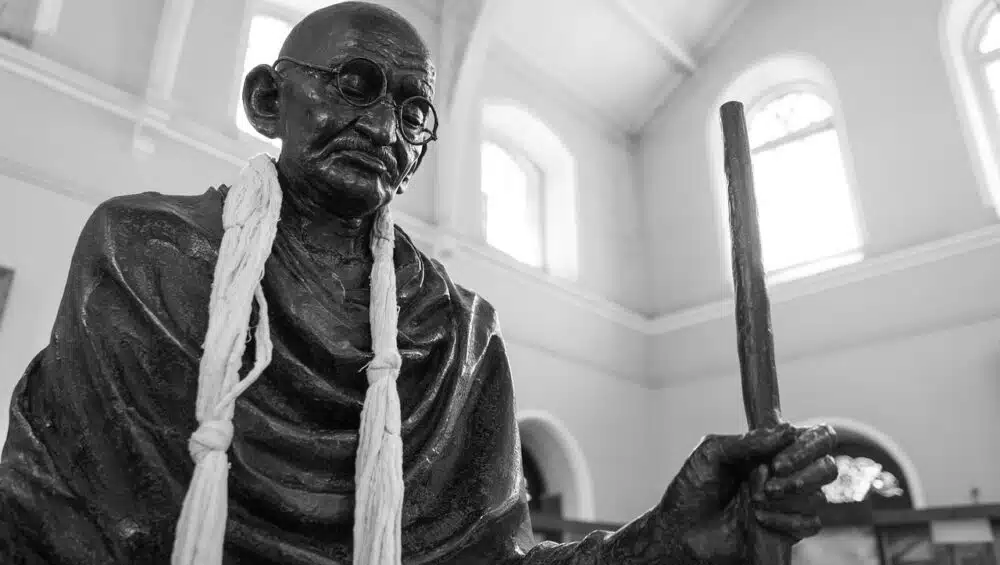
Mohandas Karamchand Gandhi, known as Mahatma Gandhi, is one of the most influential and emblematic figures in the history of India and the Indian independence movement. Nicknamed the "Mahatma", meaning "Great Soul", Gandhi left an indelible legacy as a political leader, philosopher and tireless advocate of human rights and non-violence.
Gandhi was born in 1869 into a modest family in western India. His legal education took him to South Africa, where he witnessed racial injustice and developed his unique vision of non-violent resistance. It was there that he put into practice the first elements of his philosophy, Satyagraha, which literally translates as "the power of truth". This concept was based on passive resistance, civil disobedience and the search for truth and justice through peaceful means.
The Independence Movement
Gandhi returned to India in 1915 and was soon recognised as the leader of the independence movement. His campaign of non-cooperation encouraged Indians to reject British rule by refusing to cooperate with the colonial authorities. His methods, such as hunger strikes and salt marches, mobilised the Indian masses and drew worldwide attention to the cause of independence.
One of Gandhi's most important contributions to world political thought was his promotion of non-violence as a means of struggle. He believed that violence begets more violence, and that only non-violence could break this destructive cycle. His philosophy influenced many civil rights and social justice movements around the world, including the movement led by Martin Luther King Jr. in the United States.
Gandhi's legacy
Gandhi's life was imbued with simplicity. He advocated truth, frugality and equality for all. His minimalist lifestyle, simple dress and pursuit of self-sufficiency inspired generations of people to live in harmony with nature and to challenge materialistic norms. Gandhi believed in a society where caste and religion did not divide, and where justice and equity were available to all.
Mahatma Gandhi remains a revered figure and a source of inspiration to millions of people around the world. His perseverance, determination and belief in non-violence demonstrated the power of peaceful social change. Gandhi proved that a determined individual, armed with ethical principles, can move mountains of injustice. His legacy lives on in movements for human rights, social justice and peace, reminding us all that non-violence is a powerful force for positive change.



Comments are closed.